One month with an Apple watch

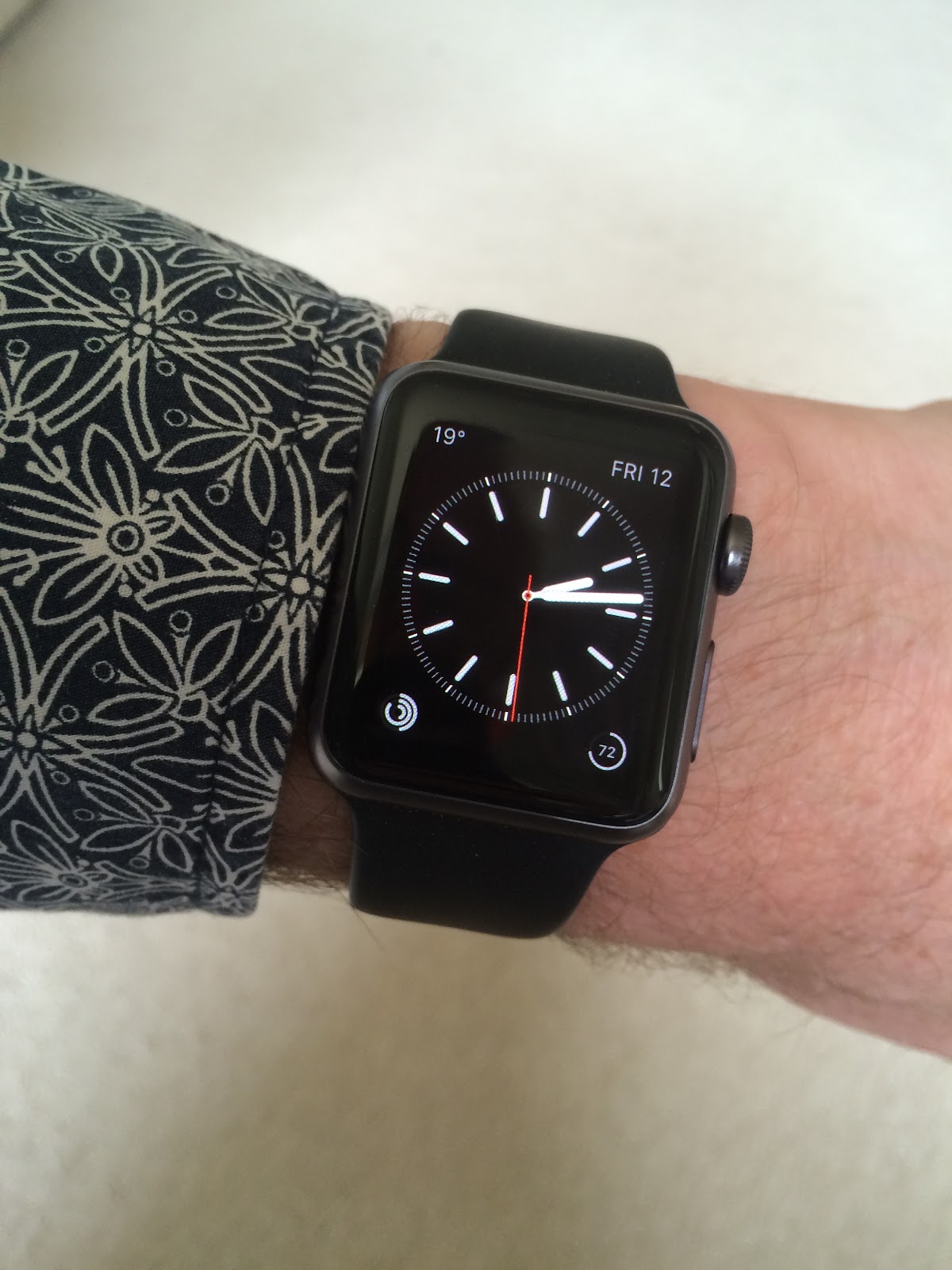 On April 11th I posted “How to justify an Apple Watch purchase” as a public rationale of why I’d ordered an Apple Watch. The watch arrived a little less than four weeks later which means I’ve now being using it for a month. I’ve worn it every day; it goes on as soon as I’m awake enough and comes off when I bathe, go to bed or (spoiler alert) change the strap. It stays on when I’m in the gym, as monitoring exercise was my key rationalisation for buying it. I think I’ve had enough experience now to make it worth recording my thoughts.
I’ll start by considering it as a watch, that is a timepiece worn on my wrist. Purely functionally it has one disadvantage compared to my electromechanical watch - the watch face is only visible when I move my wrist to angle the face towards me and the watch correctly detects that motion. It’s the second part that’s the problem, there’s what seems like only a 90% hit rate. Otherwise the watch is great, it tells the time and tells me the day of the week and date - pretty much all that my previous watch did.
 “But Roger”, you say, “what about having to charge it?”. Firstly, the battery has lasts all day for me (except when I fail to charge it). Secondly, I already have to deal with charging my phone every night (and during the day, more often than not), and since I don’t wear my watch in bed, charging isn’t a problem. Until all my gadgets (phone, laptop, toothbrush, shaver, …) run for a coupe of weeks without charging, the charger and cable isn't a problem.
The watch feels good to wear. The rubber (“custom high-performance fluroelastomer”) straps are comfortable, warm (unlike the metal strap of my previous watch) and luxurious (honest). There is a noticeable difference between my (original) black strap and my white strap; the white feels softer and warmer when you put the watch on although I can’t say I notice the difference after a couple of minutes.
 The black-watch/black-strap combination is very black and very discrete. It looks good with casual clothes or a very black outfit; ideal for the Cadbury’s Milk Tray man. With a smart suit the combination is too understated; hence my purchase of the white strap. The black-watch/white-strap combination looks good and is certainly not discrete. The proof of the difference - apart from the first day when the guy sitting next to me also had a new Apple Watch, no one has commented on the watch when I’ve been wearing the black strap, whereas I’ve had a few “Is that one of those watches?” comments when I’ve been wearing the white strap.
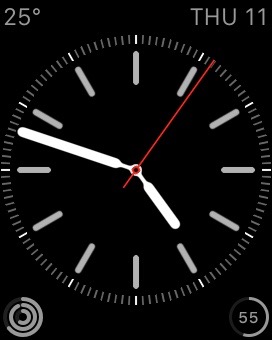
 The watch offers ten different faces, all of which can be customised to some extent. There are five faces with hands to indicate the time (“analogue”) - three are fairly standard styles, one is the “Mickey Mouse” which I’d use if I were wearing a Micky Mouse tie, and the other face is a “chronograph”. The remaining five faces all use digits to display the time, although two (“Solar” and “Astronomy”) have designs which also give an analogue indication of the time. One of the digital designs (“Modular”) looks like it was designed to be a caricature of a digital watch. As I’ve worn a watch with hands for most of the past 50 years (I suppose it’s possible there was a short period when I had a digital watch) I use the “Simple” face with medium details. As well as the time this face shows the day and date, the outside temperature, the amount of battery remaining (currently 55%) and an indication of my current exercise status. The devices indicating these extra details are called “complications” and can be chosen by the wearer. If I were travelling I might choose to show local time on the hands and the time back home on one of the complications. Similarly, if I had a busy diary I might choose to show my next appointment. The complications not only show some piece of information, they can be used to switch to a watch app. For example, if I tap on the temperature (currently 25C), the weather app opens.
 If you read “How to justify….” you’ll know I wanted the fitness features of the phone. Other than telling the time, the health and fitness features are the most obviously useful features the phone. That is, I think it is completely non-obvious (for example) that it might be useful to send a text message from your phone, whereas I think being able to measure your heart rate is an obviously useful function. I’m really pleased with the fitness aspects of the phone. I say "aspects" because there are two. The first aspect is using the watch when taking exercise. You select the “exercise” app, choose your activity, set any goal (time, distance, or calories) and press start. While you are exercising the watch measures and records your heart rate (frequently). When you’ve reached your goal the watch lets you know; alternatively you can tell the watch when you have finished. The watch then presents you with your statistics and they can be stored away if desired. The second aspect is that the watch is always recoding your activity and measuring you heartbeat, albeit less frequently than when exercising. Over the day it keeps track of how much you “exercise” (elevated heart-rate), how many calories you use, and whether you stand each hour. You can set goals for each metric. The watch keeps track of how close you are to meeting your goals, and the “fitness” app displays this using three concentric rings which fill with colour as the metrics increase. If and when you meet your goals the watch congratulates you. I like this gamification of healthy exercise - it makes me walk more and causes me not to sit slumped at my desk for hours on end. One advantage of integrating fitness functions into the watch rather than using a separate fitness band (FitBit or whatever) is that you do not get the phenomenon where after a month or so you stop using the fitness band; it’s always there when you wear the watch.

The first thing which takes the Apple Watch way beyond a combination timepiece and fitness band is its utility as a communicator. You can make and take calls on the watch and send and receive messages. That is provided your iPhone is nearby.
[My home has a landline, a DECT base-station and a handful of DECT cordless phones (handsets). The base station is wired to the landline and connected wirelessly to the handsets. I can take and make calls from the handsets as if they were connected to the landline but, in fact, I am relying on the DECT base-station to provide the connectivity to the phone network. I mention this because the relationship between the iPhone and the Apple Watch is similar. The watch works perfectly well as a communications device for phone calls and messages but it relies on the iPhone to provide its cellular and network connectivity. The watch connects to the iPhone via some combination of Bluetooth LE and Wifi. Exactly how they work and when they work isn’t completely clear to me but the resulting connectivity is better than if just Bluetooth LE were used].
 If I get a call on my iPhone, my watch taps me on my wrist and I when I raise my wrist, I can see the caller id. I can red-button the call by touching the red button, or I can take the call by touching the green button.

To make a call you bring up the “Friends” screen and select the person you want to call. You then get the option to phone, message or magic them (if they’ve also got a watch).
The watch works as a speaker phone - there’s no need to speak into the watch to be heard, nor to hold it to your ear to listen to the call. I have to admit that I still pretty daft when I use the watch as a phone but I’m sure with practice I’ll get used to it. You can read incoming messages on the watch. For outgoing there are a number of canned messages (e.g. “I’m on my way”) or you can speak and have Siri convert it to text, or send it as a voice message.


Siri works well on the watch. Perhaps Siri is as good on the phone now, but Siri is much better on the watch than it used to be on the phone. You can use Siri for all sorts of things on the watch and it’s much easier to do so than to fiddle with the buttons and small touch screen. The only thing I can’t do that I’d expect to do is to dictate e-mails.
The second thing which distinguishes the Apple Watch from a mere timepiece is that underneath it all it is a computer (as an iPhone is a computer). I’ve mentioned in passing two ways in which the computer functionality can be accessed - via complications and via Siri. You can also access computer functionality via “glances” and via apps. Glances primarily provide information but they can also take input. I have just a few glances enabled some of which let me check my heart rate, access my fitness information, see my diary, check the weather forecast, and control music playing on my iPhone. With the current (first) version of the watch’s software, apps are more limited than on the phone, however, I have a number of useful ones installed - Passbook, Shazam, Uber and the iPhone camera remote control.

 I realise that I’ve got all this way without mentioning notifications. The watch can notify you about pretty much the same things as the phone. It is really useful to get some notifications on the phone. What you realise after a short while is that you must be far more selective on the watch than on the phone. I still need to get my e-mail notifications under control - I get far to too many; I want to know when I get a new e-mail from family, not when I get a special offer from Laphroaig.

What else to say?
Firstly the 13-amp plug/USB adaptor is a work of art - Apple’s finest. It would be even better it had two USB outlets.
Secondly, despite my tweet the straps are really easy to put on and take off - nothing like the nightmare of every other watch strap I’ve ever known.
Thirdly, the watch really does free you from the phone. You don’t need to be looking at it so often. And I think glancing at your wrist is a little more socially acceptable than pulling out your phone and staring at it.
Finally a niggle. The way units are displayed in the Activity app on the iPhone isn’t right. Rather than letting you select miles or km in the app, the app determines the unit from the geographical settings on the phone. So the UK gets miles. Having spent some time puzzling and googling over this, I know I’m not the only person this affects. I’ve had a useful e-mail exchange with Jay Blahnik of Apple about this and it's being looked at.
Should you buy one? I don’t know but I’d buy one again. Maybe not the same model though.


 Posts