Showing posts with label music. Show all posts

Friday, June 12, 2015

One month with an Apple watch

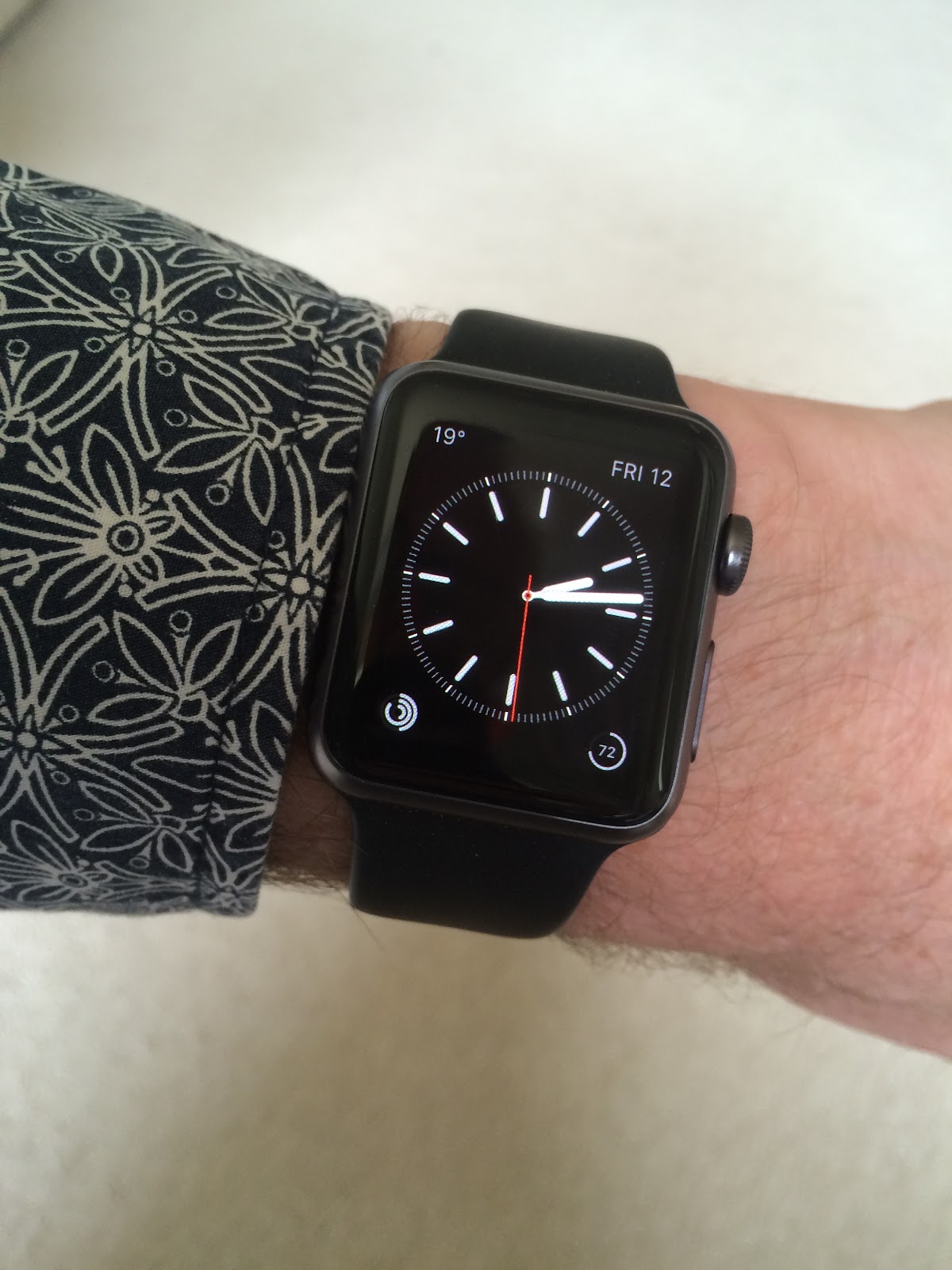
On April 11th I posted “How to justify an Apple Watch purchase” as a public rationale of why I’d ordered an Apple Watch. The watch arrived a little less than four weeks later which means I’ve now being using it for a month. I’ve worn it every day; it goes on as soon as I’m awake enough and comes off when I bathe, go to bed or (spoiler alert) change the strap. It stays on when I’m in the gym, as monitoring exercise was my key rationalisation for buying it. I think I’ve had enough experience now to make it worth recording my thoughts.

I’ll start by considering it as a watch, that is a timepiece worn on my wrist. Purely functionally it has one disadvantage compared to my electromechanical watch - the watch face is only visible when I move my wrist to angle the face towards me and the watch correctly detects that motion. It’s the second part that’s the problem, there’s what seems like only a 90% hit rate. Otherwise the watch is great, it tells the time and tells me the day of the week and date - pretty much all that my previous watch did. 

“But Roger”, you say, “what about having to charge it?”. Firstly, the battery has lasts all day for me (except when I fail to charge it). Secondly, I already have to deal with charging my phone every night (and during the day, more often than not), and since I don’t wear my watch in bed, charging isn’t a problem. Until all my gadgets (phone, laptop, toothbrush, shaver, …) run for a coupe of weeks without charging, the charger and cable isn't a problem.  

The watch feels good to wear. The rubber (“custom high-performance fluroelastomer”) straps are comfortable, warm (unlike the metal strap of my previous watch) and luxurious (honest). There is a noticeable difference between my (original) black strap and my white strap; the white feels softer and warmer when you put the watch on although I can’t say I notice the difference after a couple of minutes. 
The black-watch/black-strap combination is very black and very discrete. It looks good with casual clothes or a very black outfit; ideal for the Cadbury’s Milk Tray man. With a smart suit the combination is too understated; hence my purchase of the white strap. The black-watch/white-strap combination  looks good and is certainly not discrete. The proof of the difference - apart from the first day when the guy sitting next to me also had a new Apple Watch, no one has commented on the watch when I’ve been wearing the black strap, whereas I’ve had a few “Is that one of those watches?” comments when I’ve been wearing the white strap.

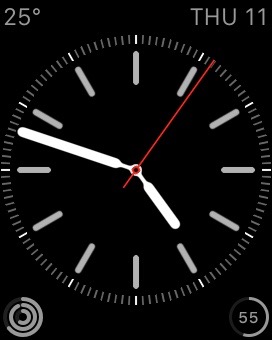
The watch offers ten different faces, all of which can be customised to some extent. There are five faces with hands to indicate the time (“analogue”) - three are fairly standard styles, one is the “Mickey Mouse” which I’d use if I were wearing a Micky Mouse tie, and the other face is a “chronograph”. The remaining five faces all use digits to display the time, although two (“Solar” and “Astronomy”) have designs which also give an analogue indication of the time. One of the digital designs (“Modular”) looks like it was designed to be a caricature of a digital watch. As I’ve worn a watch with hands for most of the past 50 years (I suppose it’s possible there was a short period when I had a digital watch) I use the “Simple” face with medium details. As well as the time this face shows the day and date, the outside temperature, the amount of battery remaining (currently 55%) and an indication of my current exercise status. The devices indicating these extra details are called “complications” and can be chosen by the wearer. If I were travelling I might choose to show local time on the hands and the time back home on one of the complications. Similarly, if I had a busy diary I might choose to show my next appointment. The complications not only show some piece of information, they can be used to switch to a watch app. For example, if I tap on the temperature (currently 25C), the weather app opens.

If you read “How to justify….” you’ll know I wanted the fitness features of the phone. Other than telling the time, the health and fitness features are the most obviously useful features the phone. That is, I think it is completely non-obvious (for example) that it might be useful to send a text message from your phone, whereas I think being able to measure your heart rate is an obviously useful function. I’m really pleased with the fitness aspects of the phone. I say "aspects" because there are two. The first aspect is using the watch when taking exercise. You select the “exercise” app, choose your activity, set any goal (time, distance, or calories) and press start. While you are exercising the watch measures and records your heart rate (frequently). When you’ve reached your goal the watch lets you know; alternatively you can tell the watch when you have finished. The watch then presents you with your statistics and they can be stored away if desired. The second aspect is that the watch is always recoding your activity and measuring you heartbeat, albeit less frequently than when exercising. Over the day it keeps track of how much you “exercise” (elevated heart-rate), how many calories you use, and whether you stand each hour. You can set goals for each metric. The watch keeps track of how close you are to meeting your goals, and the “fitness” app displays this using three concentric rings which fill with colour as the metrics increase. If and when you meet your goals the watch congratulates you. I like this gamification of healthy exercise - it makes me walk more and causes me not to sit slumped at my desk for hours on end. One advantage of integrating fitness functions into the watch rather than using a separate fitness band (FitBit or whatever) is that  you do not get the phenomenon where after a month or so you stop using the fitness band; it’s always there when you wear the watch.

The first thing which takes the Apple Watch way beyond a combination timepiece and fitness band is its utility as a communicator. You can make and take calls on the watch and send and receive messages. That is provided your iPhone is nearby. 

[My home has a landline, a DECT base-station and a handful of DECT cordless phones (handsets). The base station is wired to the landline and connected wirelessly to the handsets. I can take and make calls from the handsets as if they were connected to the landline but, in fact, I am relying on the DECT base-station to provide the connectivity to the phone network. I mention this because the relationship between the iPhone and the Apple Watch is similar. The watch works perfectly well as a communications device for phone calls and messages but it relies on the iPhone to provide its cellular and network connectivity. The watch connects to the iPhone via some combination of Bluetooth LE and Wifi. Exactly how they work and when they work isn’t completely clear to me but the resulting connectivity is better than if just Bluetooth LE were used].


If I get a call on my iPhone, my watch taps me on my wrist and I when I raise my wrist, I can see the caller id. I can red-button the call by touching the red button, or I can take the call by touching the green button.


To make a call you bring up the “Friends” screen and select the person you want to call. You then get the option to phone, message or magic them (if they’ve also got a watch).  


The watch works as a speaker phone - there’s no need to speak into the watch to be heard, nor to hold it to your ear to listen to the call. I have to admit that I still pretty daft when I use the watch as a phone but I’m sure with practice I’ll get used to it. You can read incoming messages on the watch. For outgoing there are a number of canned messages (e.g. “I’m on my way”) or you can speak and have Siri convert it to text, or send it as a voice message. 


Siri works well on the watch. Perhaps Siri is as good on the phone now, but Siri is much better on the watch than it used to be on the phone. You can use Siri for all sorts of things on the watch and it’s much easier to do so than to fiddle with the buttons and small touch screen. The only thing I can’t do that I’d expect to do is to dictate e-mails.

The second thing which distinguishes the Apple Watch from a mere timepiece is that underneath it all it is a computer (as an iPhone is a computer). I’ve mentioned in passing two ways in which the computer functionality can be accessed - via complications and via Siri. You can also access computer functionality via “glances” and via apps. Glances primarily provide information but they can also take input. I have just a few glances enabled some of which let me check my heart rate, access my fitness information, see my diary, check the weather forecast, and control music playing on my iPhone. With the current (first) version of the watch’s software, apps are more limited than on the phone, however, I have a number of useful ones installed - Passbook, Shazam, Uber and the iPhone camera remote control. 

I realise that I’ve got all this way without mentioning notifications. The watch can notify you about pretty much the same things as the phone. It is really useful to get some notifications on the phone. What you realise after a short while is that you must be far more selective on the watch than on the phone. I still need to get my e-mail notifications under control - I get far to too many; I want to know when I get a new e-mail from family, not when I get a special offer from Laphroaig.
What else to say?

Firstly the 13-amp plug/USB adaptor is a work of art - Apple’s finest. It would be even better it had two USB outlets.

Secondly, despite my tweet the straps are really easy to put on and take off - nothing like the nightmare of every other watch strap I’ve ever known.  

Thirdly, the watch really does free you from the phone. You don’t need to be looking at it so often. And I think glancing at your wrist is a little more socially acceptable than pulling out your phone and staring at it.

Finally a niggle. The way units are displayed in the Activity app on the iPhone isn’t right. Rather than letting you select miles or km in the app, the app determines the unit from the geographical settings on the phone. So the UK gets miles. Having spent some time puzzling and googling over this, I know I’m not the only person this affects. I’ve had a useful e-mail exchange with Jay Blahnik of Apple about this and it's being looked at.

Should you buy one? I don’t know but I’d buy one again. Maybe not the same model though.


Thursday, December 04, 2014

Pomplamoose

Pomplamoose are an interesting indie band. Some of their covers are great, some of their original songs are great, and some not so much to my taste. But they are nearly always entertaining and I really like the way their videos often expose the way way in which they are put together. The Pharrall Mashup (Happy Get Lucky) is a case in point.


I also find Pomplamoose interesting because they are an example of an indie band as a small business. Jack Conte (the half of the band that isn't Nataly Dawn) recently exposed the economics of their latest tour with this article on Medium.

Thursday, July 31, 2014

A Rainbow in Curved Air

Last night saw me in Bristol's Old Vic theatre for the third night in a row, this time to see and listen to a performance of Terry Riley's "A Rainbow in Curved Air" by Charles Hazlewood's All Star Collective and Danceroom Spectroscopy. I'd seen the All Stars perform the piece last year - in fact, embarrassingly, their performance was my introduction to this seminal work - and was keen to hear it again, and whatever else they'd play in the concert.

Charles Hazlewood educates the audience prior to the performance
I wasn't disappointed; not at all. Charles Hazlewood introduced the piece with a short lecture about the nature of minimalist music and explained that the night's performance would follow the form of Rilley's piece but would be improvised and that the musicians would be interacting with Danceroom Spectroscopy's visuals.

Charles Hazelwood, Will Gregory, Ross Hughes 
And what a performance it was. Danceroom Spectroscopy' visuals were spot on, a great blend of abstract, photographic and algorithmic, and I enjoyed seeing the band members interacting with the visuals. Sonically the performance was grounded in the late 1960s with parts coming straight from Rilley's original and parts sounding like they'd been sampled from the more experimental parts of Pink Floyd's The Piper at The Gates of Dawn or from the first two Soft Machine albums. The piece became very free-form at times, and just as it seemed on the edge of falling to apart Tony Orrell's drumming would bring structure back into the piece and bring the audience to edge of their seats. 

Overall a great evening. I hope someone has recorded it and a copy finds its way in to my hands. The Pit at The Old Vic was a great place to see the performance from - although the next time I'll opt for standing rather than sitting. The only other thing I'd change would be to project the visuals over the whole performance area rather than on a screen - then we'd really be back in the 60s. 

Sunday, September 04, 2011

After all these years....


The Tender Trap at The Croft, Bristol, Friday 2nd September 2011.


I just loved Talulah Gosh. After all these years, I've finally gotten to see Amelia Fletcher and Rob Pursey perform live. Wow.


Saturday, August 13, 2011

So much to do, so little time....

I'm going to get around to posting some thoughts about my recent holiday in South Africa but in the meantime here is a film about the rediscovery of a early British synthesiser.


Oramics from Nick Street on Vimeo.

Friday, April 29, 2011

Quatre vingt dix neuf anneés de guerre

It seems some people have been having an 80's fest today. My turn:
Actually, I prefer the German version - this one has English subtitles so you can study the difference in the lyrics:
There are lots of versions around; I like this Franco-German one:
And finally, a live version from 2002:
Is it the same keyboard player? I think so.


Friday, April 02, 2010

The collapse of the old

I've just read a very interesting article by Clay Sharky "The Collapse of Complex Business Models". His general argument feels sound and its specific object, the television industry, looks to me like an industry about to undergo violent reconfiguration. Whereas the music industry seems to be returning to the staple business model of the past - live performance* - television can't return to being cinema. 


* See David Bowie (2002 New York Times), TechDirt (2009), Brian Eno (2009), and Brian Eno ("On the end of and era")

Sunday, June 21, 2009

A Record Shop


Another Sunday, another Bond movie; Goldfinger this time. A bit disappointing, I'm afraid, after "Dr No" and "From Russia With Love" both of which surpassed expectation. I think Goldfinger was brought down by a silly plot despite some good acting from the players of Bond, Goldfinger and Gallore. Too many smart alec wisecracks too. I'm not sure whether I'll go to On Her Majesty's Secret Service, although I'd like to see Diana Rigg. I could go on about Bond's women and Ursula Andress and Honour Blackman are much more plausible as real women than many of today's stick insects but I'll move on to the real topic of this posting.

When I leave the midday Bond movie I get to walk up Park Street and visit the shops at leisure. This is a rare treat as I work on some god forsaken "business park" miles from anything remotely interesting. And it has lead me to forming a relationship with Fopp. I don't think I'd ever been into a Fopp until a couple of years ago when I bought something ("Sound of Speed" by
The Jesus and Mary Chain?) which was going cheap. And I certainly didn't think of Fopp as anything other than a cheap shop. But since I've started to go to the Bond movies at the Watershed, I've found that Fopp is more interesting than that - it shows all the signs of being a real record shop. I don't mean one which sell vinyl (which it does) but one which is full of people searching through the racks - people who look interested in music - and which plays interesting music. Today, wandering around the top floor, I heard this music which sounded like it came from 35 years ago. It was interesting, parts were excellent and compelling, parts were self indulgent and minimally musical. "What is it?" I wondered. It wasn't familiar so maybe it was new. So I asked. I was listening to Egg's "The Civil Surface". So, older than I thought, but it would have been 35 years since I heard any Egg. A interesting band from the Canterbury Scene; although not band members, many of the musicians later to be in Henry Cow played on their albums. Henry Cow's Concerts was my favourite album for many many years. Unfortunately I find most of my favourite music of that style, from that era, somewhat unlistenable to - with the possible exception of Hatfield and The North's The Rotters Club so I slipped downstairs without purchasing. But I didn't make it from the shop without The Eels' Electro-Shock Bluesbeing purchased. Oh the joys of record shops.
Posted by Picasa

Monday, April 06, 2009

Seasons In The Sun

I don't think I can manage this blog post without admiting that I like - up to the cheesy key change - Terry Jacks' "Seasons In The Sun". I think it's the Beach Boys organ riff and the Duane Eddy guitar line that appeal. I've known for years that the lyric is a translation of a Jacques Brel song but I'd never heard Brel's version until today when I caught
Coverville's "The Seasons In The Sun Cover Story". Very interesting podcast and recommended listening.

Amazing fact number one: Terry Jacks was producing a Beach Boys session and got them to record Seasons In The Sun but they decided not to release it. Terry Jacks then decided to record it himself and released it - it sounds very like the Beach Boys version which Brian Ibott includes iin the Coverville show.

Amazing fact number two: Terry Jacks altered the song to be much more positive than the original English translation. He also omitted the following verse:-
"Adieu, Francoise, my trusted wife, without you I'd have had a lonely life.
You cheated lots of times but then, I forgave you in the end though your lover was my friend.
Adieu, Francoise, it's hard to die when all the birds are singing in the sky. Now that spring is in the air
With your lovers ev'rywhere; just be careful, I'll be there."
I guess Sting was familiar with this when he wrote "Every Step"

Finally, there are some truely dreadful versions to be heard on Spotify.

Saturday, January 17, 2009

BBC Radiophonic Workshop

I went to the gym today and listened to a great Radio Clash podcast on my iPod. It celebrates the 50th Birthday of the BBC Radiophonic Workshop and is a really interesting listen. So download it here and give it a go.


I was surprised by how good most of the stuff sounded. And impressed by the amount of work that went into preparing the tapes etc. I had (still have, actually) a reel-to-reel recorder, I know how tedious and fiddly splicing tapes is. But in the end, splicing is easy - making music isn't.


Thursday, August 14, 2008

Wonderful Kate Bush Cover by Mike Scott

I've been catching up on my podcast listening since I came back from holiday. Thanks to Coverville, I've come across a brilliant track by Mike Scott of the Waterboys. It's a cover of Kate Bush's "Why Should I love you?" from "The Red Shoes". It's on heavy repeat on my iPod.

Sunday, March 25, 2007

Take it to The Bridge Bellatrix

On Friday evening I went along to The Polish Club to see the band my friend Eric Barton plays in - The Bridge. When I got there they were already on stage and playing. I was surprised and a little annoyed as I had wanted to catch the whole of their set.

The Bridge are an eight-piece band - drums, bass, keyboard, two guitars, three saxes and they play a mix of reggae, ska and afro-beat music. All very danceable, very well done. The mix on some of the reggae numbers was great - eat you heart out King Tubby - with wonderful drum and sax sounds. Worth seeing again.

The Bridge's performance was in two parts, with an appearance by Bellatrix Beats, a human beatbox, in between. I have to admit that Friday was the first time I'd encountered this art form. I was amazed. Actually, Bellatrix goes way beyond being a human beatbox; on stage she also plays bass guitar and cornet, sings and uses a Boss RC50 Loop-station which lets her sample herself. In her short set she covered a variety of styles but left me feeling her heart was really firmly in the jazz tradition (no - not Trad Jazz) - her version of Fever (think Peggy Lee, not Kylie or Madonna) was wonderful. I don't think the version on her My Space pages does do her live performance justice.

Wednesday, February 07, 2007

Steve Jobs on music

Steve Jobs has written an open letter about DRM and music. I'm cautious about praising it immediately because of the unreality field that surrounds Steve but it seems he is pretty spot on. Is it just me, or does he seem to be saying that way to kill DRM is to continue breaking it?

Tuesday, February 06, 2007

New Adventures in Music

I used to listen to the venerable John Peel from time to time. I'd go through phases; sometimes he would be compulsive listening, sometimes something to be sampled. What was alway great though was his "Festive Fifty". So, it was with great delight that I received a mail, via MySpace, from Dandelion Radio, telling me that they had run this year's Festive Fifty in lieu of the late Mr Peel. The bad news was, it now being February, they had stopped running the show. However, the website listed all the tracks, and thanks to the wonder of that collection of tubes, known as the internet, many of them could be heard on-line. What an education! After many months of listening only to podcasts, to be shown another world.

So what's hot? My answer is The Pipettes. Why their great Pull Shapes only made number 19 in the Festive Fifty, and not number 1 over the whole world is beyond me. There links to many of their videos on their record company's site (good quality) and loads of stuff on YouTube. The video for Pull Shapes is great, a homage to Russ Meyer.

Finally, respect due to Rocker and the rest of the Dandelion crew.

Wednesday, January 10, 2007

Steve says "Software replaces hardware"

It seems to me that when hardware designers look at the success of the iPod, they see MP3 chip wrapped in a nice package. Apple doesn't see it like that; it looks at the iPod as one component of a complete system - iPod, iTunes and the iTunes store - most of which is implemented software, not hardware. Apple's design culture is very software centric - yet they design some of the highest margin "hardware" products in the business.

This is a quote from Steve Jobs taken from a
Time article about the iPhone:

"When you need to dial, it shows you a keypad; when you need other buttons, the screen serves them up. When you want to watch a video, the buttons disappear. Suddenly, the interface isn't fixed and rigid, it's fluid and molten. Software replaces hardware."


I believe in this philosophy. Design should be software lead. Software technology is the best way to deal with complexity; hardware should be built to provide a platform for software.

Tuesday, January 02, 2007

Three things I've discovered recently

Kurt Godel starved himself to death.

Mountaineers atop Everest have seen birds flying high above them; indeed, geese have been recorded flying at 35,000 ft. Birds have a very efficient respiratory system that they inherited from the dinosaurs.

Richard Thompson has recorded a great version of Abba's Money, Money, Money. I must get a copy of his "1000 Years of Popular Music"

Saturday, December 09, 2006

Gilmour and Bowie

Earlier this year I went to see David Gilmour at the Albert Hall. One of the highlights of the evening was seeing David Bowie perform Arnold Layne. Well, the video is on the web, with the David Gilmour site having a good selection.

Monday, October 23, 2006

The Cure

The cure for what you might ask. But you'd be wrong. This post is about The Cure. In fact, it's about episodes 253 and and 254 of the Coverville podcast which are both entirely devoted to cover versions of songs by The Cure. My favourite "Just Like Heaven" by Katie Malua.

Tuesday, May 30, 2006

The revolution is available for download

I took a look at a Pink Floyd torrent site this morning at 8 am and it already had a video of last night's David Gilmour concert. I remember the saying "When the revolution comes it won't be on TV." Well, it may not be, but it will sure be available for download.

Echoes of Robert Wyatt and David Bowie

I went to see David Gilmour at the Royal Festival Hall last night. Overall a very good evening with three outstanding incidents.

Firstly, the appearance of Robert Wyatt playing trumpet during one of the songs from "On an Island". It was great to Robert live on stage again after many years.

Secondly, an absolutely stunning performance of "Echoes". The band seemed to be really into the piece and there was a very good middle section (I guess improvised) with great interactions between David Gilmour and Rick Wright. And then there was the Pink Floyd style light show. Wonderful, great, made the whole evening worthwhile. "Echoes" always was my favourite.

Thirdly, David Bowie joined on stage during the encore to sing "Arnold Layne" and the doctor's part of "Comfortably Numb". I've heard Roger Waters, Robert Wyatt, Kate Bush and Bob Geldorf sing the part but Dr Bowie surpassed them all.

Search This Blog